Five ways to make a property pay you.
Same four walls, very different outcomes depending on how you run them. Here is how each one works, where it shines, and where it bites.
House Hacking
You live in the property and let other people help pay for it. It is the lowest-risk way most people start investing, because you can often buy with a small down payment on an owner-occupied loan, then offset your mortgage with rent.
The flavors
- Rent out individual bedrooms while you live in one
- Buy a small multifamily, live in one unit, rent the others
- Add or rent an ADU, a basement suite, or a garage apartment
- In rural spots, even a second home on the same lot can work
The trade-offs
Benefits: low money down, real-world landlord experience, and a mortgage someone else helps cover. Drawbacks: you share space or a building with tenants, and you have to actually want to live there for a while. The tax angle: you can typically deduct the rented portion's share of expenses and depreciation, while still keeping a primary-residence footing on the part you live in.
Short-Term Rentals
Furnished nightly or weekly stays, run like a small hospitality business. The upside is the highest revenue per night of any strategy, and on the right property, strong cash flow. The cost is that it is the most hands-on, with cleaning, guest communication, and seasonality to manage.
Why investors love it
- Top-line revenue well above a long-term lease
- You keep flexibility to use the property yourself
- It is a real business, with real systems you can scale
The tax angle worth knowing
Short-term rentals get unique treatment. With the right average-stay and participation rules, plus a cost segregation study and bonus depreciation, high-income earners and real estate professionals can sometimes use paper losses to offset other income. This is powerful and situation-specific, so run it by your CPA before you bank on it.
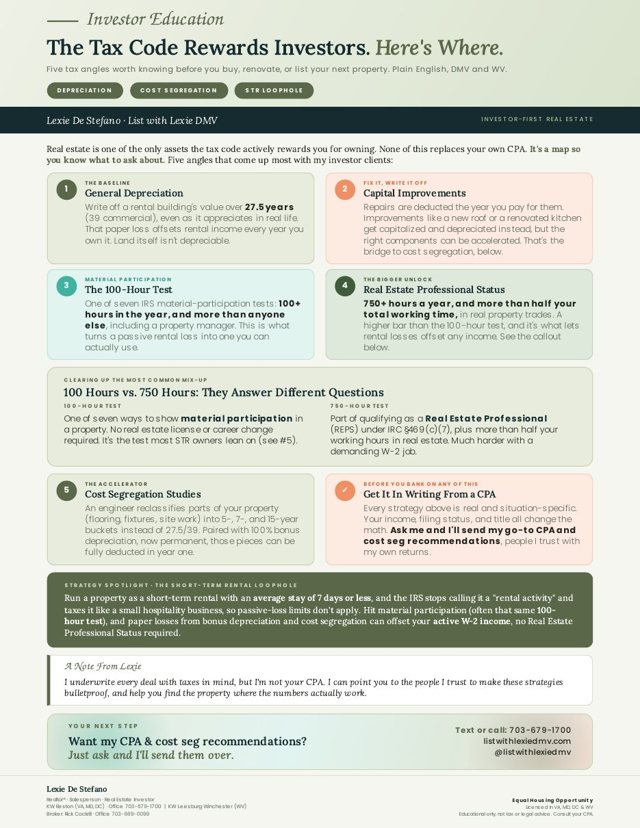
Know what the tax code owes you.
My one-page breakdown of the real tax benefits of owning investment real estate: depreciation, write-offs for capital improvements, material participation, Real Estate Professional Status, cost segregation, and the short-term rental loophole that lets some investors offset W-2 income. Not tax advice, just the map so you know what to ask your CPA.
Got it.
I will reach out with my CPA and cost segregation recommendations. In the meantime, the guide is right here.
Download the GuideMid-Term Rentals
Furnished housing, usually the entire unit, leased in stretches of 30 days or more. It sits right between short and long term, and it is often the sweet spot: higher rent than a standard lease, far less turnover and management than a nightly rental.
Who actually rents these
- Travel nurses and traveling professionals
- Remote workers and digital nomads
- People mid-transition: a divorce, a marriage, or buying a home but not ready for a year lease
- Patients in town for extended medical treatment
- A more comfortable, cost-effective option than a long hotel stay for business trips
How it pencils
Rents land above long-term and below nightly, with flexible leases that pivot as life changes. Utilities are typically included or billed back each month, so you are not eating surprise costs. Less churn than short-term means fewer cleanings, fewer gaps, and a calmer operation, while still beating standard rent.
Furnish it right the first time.
My full room-by-room furnishing and setup checklist for short-term and mid-term rentals, just as useful for a long-term rental or your own move-in day. Grab what applies to your space and skip the rest.
Your guide is ready.
Tap below to download it now. I'll also send a copy to your email in case you want it later.
Download the GuideLong-Term Rentals
The bread and butter of rental investing. A standard lease, usually a year, that often rolls to month-to-month afterward. It is the least time-intensive strategy to manage, and the most predictable, which is exactly why so many portfolios are built on it.
The case for it
- Lowest management load of any strategy
- Steady, predictable monthly income
- Simple to finance and simple to scale
The honest trade-off
Long-term rent is usually the lowest of the five strategies, so cash flow per door is thinner, especially in pricier areas where the smart play is often appreciation rather than monthly cash flow. The win is durability: set it up right, and it largely runs itself while it builds equity and wealth in the background.
Co-Living
Rent by the room instead of by the house. Each bedroom gets its own lease, usually furnished, with shared kitchen and living space. Done right, a single home produces more revenue per square foot than any whole-unit lease, and one vacancy dents your month instead of erasing it. I have run this play for clients, including a co-living pivot near Quantico that closed with roughly $50,000 in day-one equity.
Why the numbers get interesting
- Room-by-room rent typically clears a whole-unit lease by a wide margin
- Diversified income: four leases, not one, so a turnover never takes you to zero
- Steady demand near employment centers, bases, and hospitals across the DMV
- Works in an ordinary single-family house, no multifamily purchase required
What actually makes or breaks it
Zoning matters more here than in any other strategy. Many DMV jurisdictions cap occupancy per dwelling and some require a rental license or inspection, so I confirm the rules before we write an offer, not after. Layout is the other half: bedroom count, bathroom ratio, and common space that people actually want to share. Management is more active than a standard lease, and house rules belong in the lease itself. Run it like a small operation and it rewards you. Run it casually and it will not.